Data Science & AI in 2026: A Complete Beginner’s Roadmap to Start Your Career
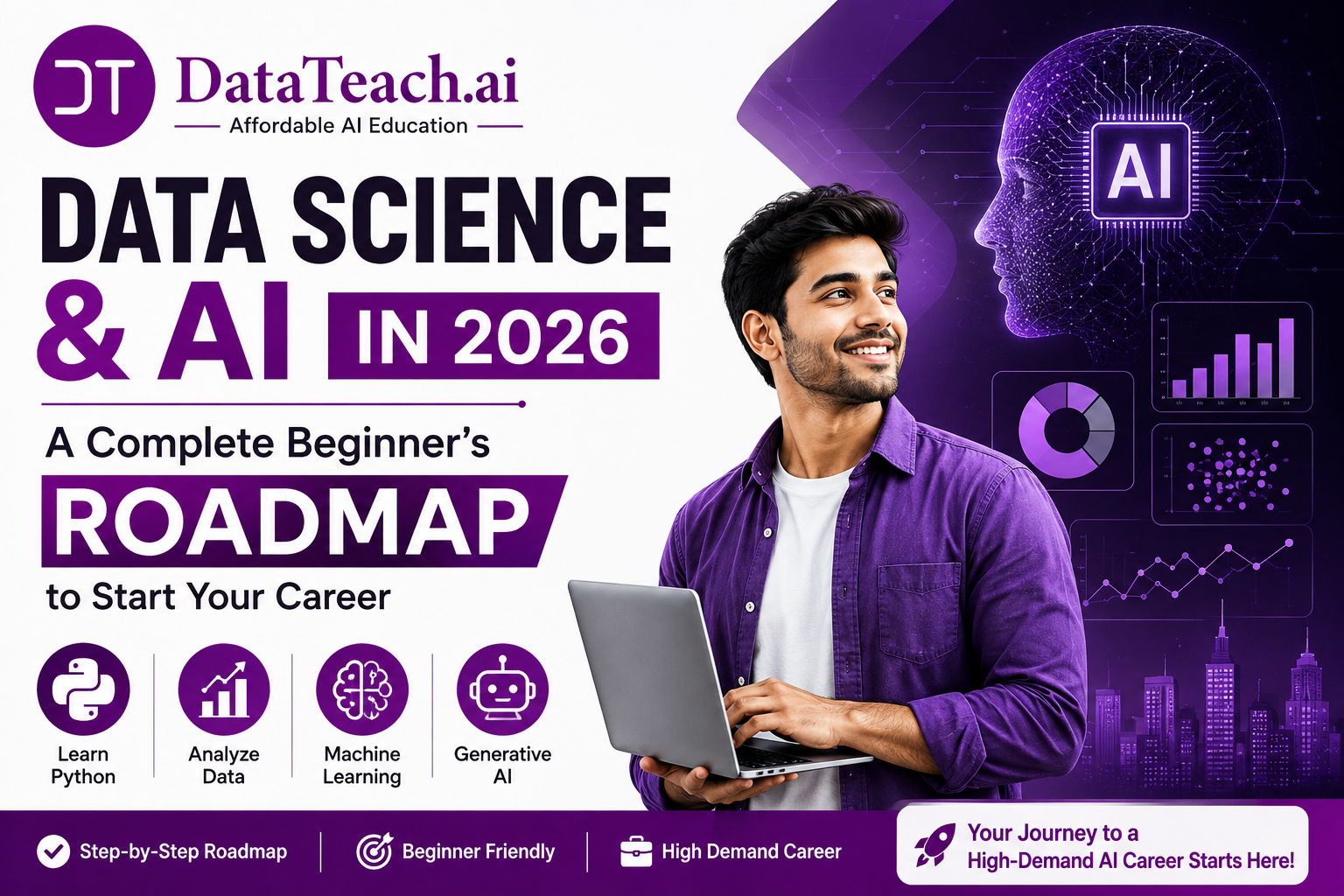
Data Science & AI in 2026: A Complete Beginner’s Roadmap to Start Your Career
Artificial Intelligence is no longer a futuristic concept—it is transforming healthcare, banking, education, e-commerce, agriculture, cybersecurity, and almost every modern industry. Companies are actively looking for professionals who can analyze data, build machine learning models, automate decisions, and work with Generative AI tools.
If you are a student, working professional, career switcher, or someone returning after a career gap, this guide will help you understand how to start a successful career in Data Science and AI in 2026.
At Datateach AI, our mission is simple: Affordable AI Education for Everyone. We believe that quality AI learning should be accessible to every learner, regardless of their background.
🌐 Website: https://www.datateach.ai
Why Data Science and AI Are the Most In-Demand Skills in 2026
Businesses today generate massive amounts of data every second. However, data becomes valuable only when it is converted into insights, predictions, and intelligent decisions.
Industries hiring Data Science and AI professionals
- IT & Software
- Banking & FinTech
- Healthcare
- Retail & E-commerce
- Manufacturing
- Telecommunications
- EdTech
- Digital Marketing
- Government & Smart City Projects
The demand for professionals skilled in Python, Data Analytics, Machine Learning, Deep Learning, and Generative AI is growing rapidly across India and globally.
What Is Data Science?
Data Science is the process of collecting, cleaning, analyzing, visualizing, and interpreting data to solve business problems.
A typical Data Science workflow
- Collect data
- Clean and preprocess data
- Analyze patterns
- Visualize insights
- Build predictive models
- Deploy solutions
Example
An e-commerce company can use Data Science to:
- Predict which customers may stop purchasing
- Recommend products
- Forecast future sales
- Detect fraudulent transactions
What Is Artificial Intelligence?
Artificial Intelligence (AI) enables machines to perform tasks that usually require human intelligence, such as:
- Understanding language
- Recognizing images
- Making recommendations
- Predicting outcomes
- Generating content (text, images, code, audio)
Types of AI skills in demand
| Skill Area | Examples |
|---|---|
| Machine Learning | Prediction models |
| Deep Learning | Image & speech recognition |
| Natural Language Processing | Chatbots, sentiment analysis |
| Computer Vision | Face detection, object tracking |
| Generative AI | ChatGPT, AI assistants, content generation |
Step-by-Step Roadmap to Learn Data Science & AI
Step 1: Learn Python
Python is the foundation of modern Data Science and AI.
Topics to learn
- Variables and data types
- Conditional statements
- Loops
- Functions
- Lists, tuples, dictionaries, sets
- File handling
- Object-oriented programming basics
Why Python?
- Easy for beginners
- Huge AI ecosystem
- Used by companies worldwide
- Excellent community support
SEO Keywords: learn Python for Data Science, Python course for beginners, Python programming for AI
Step 2: Master Data Analysis with NumPy and Pandas
NumPy
Used for:
- Arrays
- Mathematical operations
- Statistical computations
- Linear algebra basics
Pandas
Used for:
- Reading CSV/Excel files
- Cleaning missing values
- Filtering data
- Grouping and aggregation
- Time-series analysis
Mini Project Idea
Analyze a student performance dataset to find:
- Average marks
- Top-performing students
- Subject-wise performance trends
Step 3: Learn Data Visualization
Visualization helps communicate insights clearly.
Essential libraries
- Matplotlib
- Seaborn
Create charts such as
- Bar charts
- Line charts
- Histograms
- Heatmaps
- Scatter plots
Practical Example: Visualize monthly sales performance of a retail company.
Step 4: Understand Statistics for Data Science
Many beginners skip statistics, but it is crucial for building reliable models.
Important concepts
- Mean, median, mode
- Standard deviation
- Probability
- Correlation
- Hypothesis testing
- Normal distribution
These concepts help you interpret data correctly and avoid misleading conclusions.
Step 5: Learn Machine Learning
Machine Learning allows computers to learn patterns from data.
Supervised Learning
- Linear Regression
- Logistic Regression
- Decision Trees
- Random Forest
- Support Vector Machines
Unsupervised Learning
- K-Means Clustering
- Hierarchical Clustering
- PCA (Dimensionality Reduction)
Beginner Project
House Price Prediction System
Input:
- Area
- Bedrooms
- Location
- Age of property
Output:
- Predicted house price
This is one of the most popular Machine Learning projects for beginners.
Step 6: Explore Deep Learning
Deep Learning is a subset of Machine Learning inspired by the human brain.
Tools
- TensorFlow
- PyTorch
- Keras
Applications
- Image classification
- Face recognition
- Medical image analysis
- Speech recognition
- Autonomous vehicles
Step 7: Learn Generative AI
Generative AI has become one of the hottest technologies in 2026.
What you should learn
- Prompt Engineering
- Large Language Models (LLMs)
- AI assistants
- Retrieval-Augmented Generation (RAG)
- AI-powered automation workflows
Real-world use cases
- Content generation
- Resume optimization
- Customer support chatbots
- Code generation
- Report summarization
- AI teaching assistants
SEO Keywords: Generative AI course, Prompt Engineering training, AI automation course
Essential Tools Every Beginner Should Know
| Category | Tools |
| Programming | Python |
| Notebook | Jupyter Notebook |
| Data Analysis | NumPy, Pandas |
| Visualization | Matplotlib, Seaborn |
| Machine Learning | Scikit-learn |
| Deep Learning | TensorFlow, PyTorch |
| Database | SQL |
| BI Tool | Power BI |
| Version Control | Git & GitHub |
Best Projects to Build Your Portfolio
Recruiters care more about projects and practical skills than certificates alone.
Recommended beginner projects
1. Student Result Analysis
- Data cleaning
- Visualization
- Performance insights
2. Sales Dashboard
- Monthly revenue analysis
- Regional performance comparison
- Interactive charts
3. Customer Churn Prediction
- Identify customers likely to leave
- Build a classification model
4. Movie Recommendation System
- Content-based filtering
- Similarity scoring
5. AI Resume Analyzer
- Extract skills from resumes
- Match with job descriptions
- Generate improvement suggestions using Generative AI
Common Mistakes Beginners Make
❌ Learning too many tools at once
Focus on Python → Pandas → Visualization → Machine Learning.
❌ Watching tutorials without practice
Spend 70% of your time coding.
❌ Ignoring projects
Projects demonstrate problem-solving ability.
❌ Avoiding SQL
SQL remains one of the most important skills for Data Analysts and Data Scientists.
How Long Does It Take to Become Job-Ready?
Suggested learning timeline
| Month | Focus |
| Month 1 | Python fundamentals |
| Month 2 | NumPy, Pandas, Visualization |
| Month 3 | Statistics and SQL |
| Month 4 | Machine Learning |
| Month 5 | Projects and portfolio |
| Month 6 | Generative AI and interview preparation |
With consistent daily practice (2–3 hours), many learners can build a strong foundation within 6 months.
Career Opportunities After Learning Data Science & AI
Entry-level roles
- Data Analyst
- Junior Data Scientist
- Business Analyst
- Machine Learning Engineer (Fresher)
- AI Associate
- Python Developer
- BI Analyst
Skills that increase your salary potential
- SQL + Python
- Power BI
- Machine Learning
- Cloud basics
- Generative AI
- Communication & storytelling with data
Why Choose Datateach AI?
At Datateach AI, we focus on practical, industry-oriented, and affordable AI education.
What makes us different?
✅ Beginner-friendly curriculum
Designed for students, graduates, working professionals, and career switchers.
✅ Live instructor-led sessions
Learn directly from industry experts with real-world experience.
✅ Hands-on projects
Build projects in:
- Data Analytics
- Machine Learning
- Generative AI
- Exploratory Data Analysis (EDA)
✅ Internship-oriented learning
Gain exposure to real datasets and practical workflows.
✅ Affordable pricing
We are committed to democratizing AI education in India by offering high-quality training at an affordable cost.
🌐 Explore our programs: https://www.datateach.ai
Frequently Asked Questions (FAQ)
Is coding mandatory for AI?
Basic coding—especially Python—is highly recommended for building real AI applications.
Can a non-IT student learn Data Science?
Absolutely. Learners from ECE, Mechanical, Civil, Commerce, Arts, and Science backgrounds can successfully transition into Data Science with proper guidance.
Which is better: Data Analytics or Data Science?
- Data Analytics: Focuses on understanding past and present data.
- Data Science: Includes analytics plus predictive modeling and AI techniques.
For beginners, starting with Data Analytics and then moving to Data Science is often the easiest path.
Do I need a mathematics background?
You need basic mathematics and logical thinking. Advanced mathematics can be learned gradually as you progress.
Final Thoughts
The best time to start learning Data Science and Artificial Intelligence is now. The field is growing rapidly, opportunities are expanding across industries, and organizations are looking for professionals who can combine analytical thinking with AI-powered problem solving.
Remember this simple roadmap:
Python → Data Analysis → Visualization → Statistics → Machine Learning → Deep Learning → Generative AI
You do not need to become an expert overnight. Consistent practice, real projects, and proper mentorship are the keys to success.
If you are ready to begin your AI journey, Datateach AI is here to help you learn industry-ready skills through practical, affordable, and career-focused training.
Ready to Start Your AI Career?
🚀 Join Datateach AI Today
- Live Online Training
- Hands-on Projects
- Machine Learning & Generative AI
- Internship Support
- Affordable AI Education
🌐 Website: https://www.datateach.ai
📩 Contact: info@datateach.ai
📱 Follow Datateach AI for daily AI & Data Science learning resources, interview preparation tips, and project ideas.